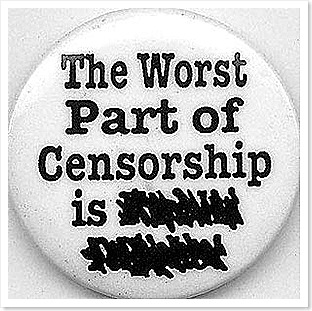
“Censorship is advertising paid by the government.” - Federico Fellini, Renowned Italian Film Director
Internet censorship is not a new concept. The greatest examples of it can be found in countries like China and Iran where over 5 million websites have been blocked by the government. Many of these websites are considered to be inappropriate for having anti-religious information or serve as a haven for political dissidents. Reporters Without Borders, a Paris-based NGO, has even developed an index that measures the level of censorship; countries like Iran and China, among others, are categorized as “enemies of the internet”.
Now, I guess it's no surprise that most of the “internet enemies” are also totalitarian regimes and their violation of human rights have been well-documented. But should governments even have the authority to control the content of the web? Should they be able to control what YOU can view online? What happens in totalitarian states seems to be out of our control, but recent developments in India, a democratic nation, have been causing global concern.
The Delhi High Court recently passed a law which orders a number of websites, including web giants Google, Facebook, and Yahoo, to “delete inflammatory images of religious figures” and remove any “objectionable or offensive content”. In an effort to make a clearer statement, a spokesperson said this law pertains to online content that is “harmful, threatening, abusive, harassing, blasphemous, defamatory, pornographic, libellous, invasive of another’s privacy, hateful, disparaging, racially, ethnically or otherwise objectionable, relating to money laundering or gambling.” The full article can be read here: http://searchengineland.com/free-speech-battle-in-india-google-facebook-summoned-by-court-over-inflammatory-images-105644
With over 100 million users, India has the third largest Internet audience. India is known to protect free speech and has taken a liberal stand on Internet censorship in the past. I am of the opinion that people should be able to have free access of the Internet as long as their activity is not malicious or offensive to anyone. Furthermore, the only involvement governments should have in regulating the Internet, is to ensure that these conditions are met; not to decide what Internet users can and cannot do.
The problem with the law in India is that it's not very specific and is subject to people's interpretation. For example, my idea of “offensive” content is different than someone else's. Furthermore, it leaves companies like Facebook and Google in an impossible situation. Pre-screening everything that gets uploaded on these websites is impractical. As such, companies like Google and Facebook have appealed to the Indian government for some leniency. Furthermore, it seems wrong to hold the websites liable for the content users upload. While the intentions of the Indian government are in good faith, the consequences of this law are significant and far-reaching. For example, anyone can now claim that some online content is offensive or defamatory.
There is little doubt why the passing of the law has raised so much concern. Such a precedence can be a dramatic change in a democratic society. The question now becomes, if traditionally free and liberal governments begin to adopt such policies, where will the line between freedom of expression and preserving respect be drawn? Also, what role will governments play in determining the content of the Internet?

No doubt that this type of activity is diminishing freedom as we know it. In these cases, governments are getting too involved in controlling user content. But remember, ultimately this type of activity is for the well being of society, so we can't fully oppose it either. A solution would be to find a middle ground between free speech and pervasive content to ensure an equilibrium is achieved.
ReplyDeleteI concur. Finding the middle ground is important in this situation. Whatever the ultimate decision is, it's important to tread carefully in this ground. As I mentioned earlier in the post, the intentions of governments are largely held in good faith. Ideally they look to maximize satisfaction for the greater good. The problem is either side of the fence (free speech vs censorship) will always anger some group of people.
DeleteI personally think censorship of web content by the government should not be allowed whether it is or isn't for the well being of society. A government has every right to be wary of and against what the people of the country are viewing, reading or accessing but I feel the decision to censor certain material found on the internet should be a decision left to the user.
ReplyDeleteWhile a government can set standards as well as guide and perhaps influence the people of a country to speak, act and behave a certain way due to political, cultural or other beliefs, only the user can ultimately decide what they want to be exposed to (or not) and how they will use their personal freedom to do so.
Possible solution to government censorship and putting companies like Facebook and Google in difficult positions: some type of internet browser feature allowing a user to personally censor parts of the internet. That way, the user could personally decide what material or webpages they would and would not like to see on the internet by selecting categories of web content (i.e. sexism, racism etc) that they would like blocked. So while browsing websites that material would be censored.
I understand your point, and while it does have merit, I think it is too risky and leaves too much information in the hands of users. It can become far too easy for information to be abused. I think users should have the ability to control and browse through the content that is "viewable". However, the determination of what is "viewable" should be left to a third party, ideally the government.
DeleteConsidering that all citizens of a country must abide by the same laws, customs, and traditions, I think they should also have guidelines based on a nation's cultural values to decide on what is appropriate.
Variations of your proposed solution are already in effect. Browsers have filtering options and parental controls, but these prove to be ineffective. People will gain access to the information they seek at almost any cost. I don't necessarily think that governments should have absolute control over these decisions, but current solutions aren't really doing the job.